
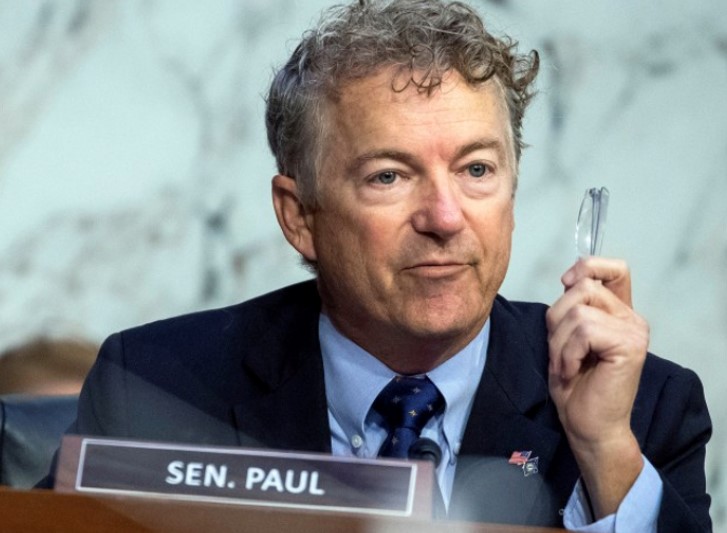
Sen. Rand Paul is done being polite to Dr. Anthony Fauci. Following the former NIAID Director's behavior before the Senate's COVID committee last week in which he invoked the Fifth Amendment more than 100 times, the Kentucky Republican and chairman of the Senate Homeland Security Committee announced that if his committee passes a contempt resolution against Fauci, he won't route it through the usual congressional slow-walk. He'll send it directly to the Department of Justice for criminal prosecution. "We have a law in Congress that if you will not testify and help an investigation, it's called contempt of Congress," Paul said. "It's a felony."
Fauci's legal team has argued that testifying could expose him to perjury charges — which is a fascinating defense when you think about it for more than three seconds. The man who spent two years telling Congress he had nothing to hide and received a blanket federal immunity for the entire time he was both President Trump and President Biden's Chief Medical Advisor now can't testify because he might accidentally commit a crime while doing it. His attorneys are essentially arguing that the truth is legally dangerous for their client.
Senator Paul addressed the pardon question directly. Fauci received a presidential pardon covering potential crimes from 2014 through January 2025. His lawyers have pointed to that pardon as a shield. But Paul's argument is simple: the pardon covers past conduct. Refusing to testify before Congress in 2026 is a new act — a separate potential crime that Joe Biden's blanket pardon doesn't touch. "Can someone plead the fifth? Can they plead their constitutional right not to incriminate themselves when they've already been given immunity through a pardon?" Paul asked.
That's the legal trap, and it's elegant. If the pardon covers everything Fauci did, then he has nothing to incriminate himself about — meaning the Fifth Amendment claim collapses. If the pardon doesn't cover everything, then there are crimes the pardon missed, and Congress has every right to investigate them. Either way, sitting in a Senate hearing room and stonewalling over a hundred questions isn't a legal strategy. It's an obstruction.
Paul is also pushing to restructure the position Fauci held for decades. The NIAID director role is currently a career civil service position — no Senate confirmation required, no presidential appointment, no meaningful oversight. Fauci ran it for 38 years. Paul wants to divide it into three separate roles, each requiring Senate approval. "He had too much power and for too long," Paul said.
The broader pattern is worth noting. Fauci testified freely and prolifically when cameras were rolling and his answers were crafted talking points about "following the science." He did interviews, press conferences, magazine covers, documentary appearances. The moment the questions got specific — about EcoHealth Alliance funding, about NIH grant oversight, about what he knew and when he knew it regarding the Wuhan Institute of Virology — the camera-ready scientist became a Fifth Amendment enthusiast.
A contempt referral that actually lands at a DOJ willing to prosecute it changes the calculation entirely. Fauci's legal team built their strategy around running out the clock — delay, invoke, pardon, repeat. That strategy assumed the referral would die in committee or gather dust at Main Justice.
The pardon was supposed to be the firewall. The Fifth was supposed to be the backup. Now the chairman of the investigating committee is sending the case straight to a prosecutor, and the incoming AG isn't known for losing interest in cases that land on his desk.