
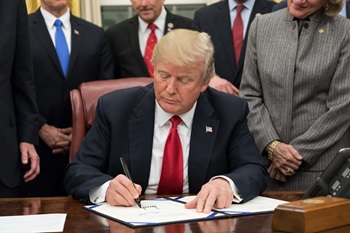
Nine pharmaceutical companies walked into the Oval Office on this week and signed Most Favored Nation (MFN) pricing agreements with President Trump. In a single afternoon, the share of the branded drug market covered by MFN deals jumped to nearly 90%.
The nine companies — Alcon, Astellas Pharma, BeOne Medicines, BridgeBio, CSL, Kyowa Kirin, Sun Pharma, Teva Pharmaceuticals, and UCB — join a roster that already included AstraZeneca, Eli Lilly, Novo Nordisk, Amgen, Bristol Myers Squibb, and Johnson & Johnson. The total number of MFN agreements now sits between 18 and 26, all negotiated since fall 2025, as reported by Breitbart.
President Trump framed the announcement as part of his "fall affordability" push, timed to land right before Labor Day. "I'm thrilled to announce a major expansion of one of our signature affordability" initiatives, Trump said from the Oval Office.
The drugs affected aren't niche medications. We're talking treatments for hemophilia, Parkinson's disease, macular degeneration, glaucoma, liver disease, skin conditions, and various cancers. The MFN model is straightforward: Americans pay the lowest price that any other country negotiates. If Germany gets a deal, we get that deal. If Japan gets a better one, we get that one.
Beyond pricing, the batch includes $19.6 billion in collective commitments to build pharmaceutical manufacturing capacity inside the United States. That's not charity — it's companies locking in favorable terms by bringing production home.
The deals also include contributions to the national strategic pharmaceutical reserve. UCB committed 163 tons of levetiracetam, an anticonvulsant. Sun Pharma pledged 71.4 tons of clindamycin and 6.75 tons of doxycycline — both antibiotics. Teva added 45 metric tons of metronidazole and 4.8 tons of amlodipine. Astellas contributed 25 kilograms of tacrolimus, an immunosuppressant used in organ transplant patients.
The strategic reserve matters because COVID exposed exactly what happens when we rely on foreign supply chains for critical medications. Shelves went empty. Hospitals rationed. The next pandemic — or the next trade war — doesn't have to play out the same way.
Democrats spent years campaigning on drug prices. The Inflation Reduction Act allowed Medicare to negotiate prices on a handful of drugs — ten, to be exact, in the first round. That was treated as a historic achievement. Trump has now locked in MFN pricing across nearly the entire branded market, covering dozens of drug categories, and extracted billions in domestic manufacturing investment on top of it.
Gas prices are down. Beef deals are done. And now the pharmacy counter is getting the same treatment.
Twenty-six deals, $19.6 billion in manufacturing, 90% of the branded market. The companies that said it couldn't be done are the ones signing the paperwork.