

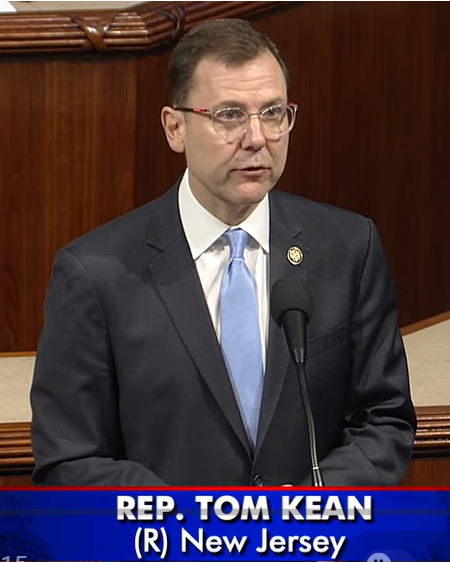
Rep. Tom Kean Jr. stepped onto the House floor Monday morning for the first time in nearly four months. The 57-year-old New Jersey Republican had missed 140 consecutive roll call votes — a 100% absence rate, according to GovTrack — without giving a public explanation. Washington loves a mystery, and Kean's empty seat had become one of the biggest on Capitol Hill.
The good thing is that Rep. Kean didn't come back with a spin doctor or a carefully lawyered statement. He came back with a diagnosis.
Kean told his colleagues he'd been hospitalized for testing back in early March 2026 and was subsequently diagnosed with clinical depression. Standing at the microphone in a chamber that usually rewards evasion, the two-term congressman from New Jersey's 7th District said what almost nobody in politics ever says out loud: "When people hear the word depression, many people think it simply means feeling sad, but depression is so much more than that. It is physical, it is emotional, and until you experience it yourself, it is difficult to fully understand how powerful this illness can be."
Kean pointed to the scale of the problem beyond his own experience. Roughly 48 million Americans are currently being treated for depression. That's not a niche affliction. That's a stadium full of people in every state, across every demographic, most of whom never talk about it because the stigma is still suffocating — especially in professions where showing vulnerability gets you primaried, polled, or pitied.
"I'm grateful that I accepted help, because today I stand before you stronger, healthier and excited to return to the work that I love," Kean said. No equivocation. No attempt to reframe four months of silence as some kind of strategic retreat. Just a man telling the room what happened and why.
Watch Rep. Kean's full remarks and explanation for yourself...
House Speaker Mike Johnson reportedly welcomed Kean's return, though Republican leadership had maintained they were unaware of the specifics of his condition during the absence. That claim is worth noting without embellishment — in a building where rumors travel at the speed of a group text, a four-month disappearance without leadership asking hard questions is either remarkable restraint or remarkable incuriosity. Either way, Kean is back in the fold, and the razor-thin Republican majority just got slightly less razor-thin.
The political reality hasn't paused for anyone's recovery, of course. The Cook Political Report rates New Jersey's 7th District as a "Toss-up." Rebecca Bennett, a former Navy helicopter pilot, is the Democratic challenger, and she has the backing of Gov. Mikie Sherrill's political operation. President Donald Trump has endorsed Kean, which shores up the base but doesn't change the math in a district where every percentage point is a knife fight. Four months of missed votes and an opponent who can say "I showed up" is a real liability in a race that tight.
Bennett's campaign, to their credit, has reportedly kept the tone measured so far. Whether that holds through October is a different question. The temptation to weaponize a mental health absence in a toss-up race will test whatever decency remains in modern campaign consulting.
But here's what Kean's speech actually did that most of Washington can't manage: it made the political calculation secondary to the human one. A congressman stood up, said he'd been struggling, said he got help, and said he's better. In a city that runs on carefully curated images of invincibility, that's not weakness. That's the opposite.
Forty-eight million Americans know exactly what Kean described on that floor. The physical weight of it. The way it doesn't care about your title or your salary or how many votes you've cast. Most of them will never have a microphone or a chamber full of colleagues listening.
Kean did. And he used it to say the thing almost nobody in his position ever does.
The 7th District race is going to be ugly regardless. That's the nature of competitive seats in a midterm cycle. But whatever happens in November, the floor speech stays in the Congressional Record — one of the rare entries worth reading twice.