
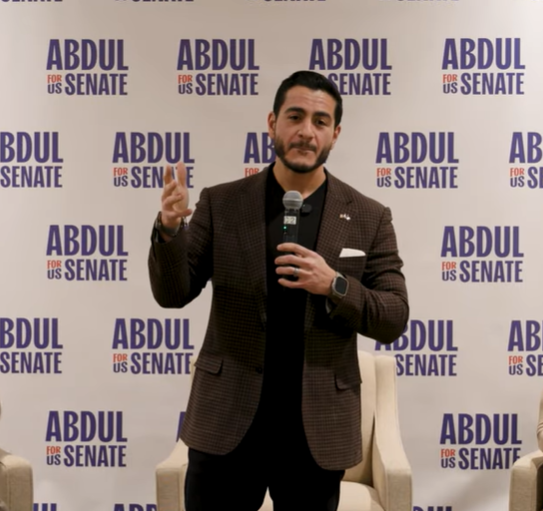
Abdul El-Sayed, the Michigan Democrat who won his Senate primary on August 4, once stood in front of a CAIR audience and compared banning Sharia law in American courts to the Trail of Tears. His exact words, from an October 2022 speech: "You can't understand a Sharia ban without understanding the Trail of Tears" and the "same exact forces that drove native peoples... are alive and well today."
Seven states have already banned courts from considering foreign and religious laws, including Sharia. El-Sayed thinks that's the moral equivalent of ethnic cleansing.
The speech wasn't some off-the-cuff remark at a town hall. It was a prepared address to the Council on American-Islamic Relations — the same CAIR that Governors Greg Abbott of Texas and Ron DeSantis of Florida designated as a foreign terrorist organization in late 2025. El-Sayed accepted $115,000 in donations from CAIR-linked individuals. Oklahoma voters banned Sharia considerations from their courts by ballot measure back in 2010. The Texas Republican Party platform includes a similar resolution. These aren't fringe positions — they're mainstream voter preferences in state after state.
El-Sayed also stressed the "importance of having empathy for terrorists" during his public remarks. That's not a paraphrase. That's what the man said.
He beat former Representative Haley Stevens in the Democratic primary and now faces former Representative Mike Rogers in the general election. Rogers holds a 0.3-point polling advantage — essentially a dead heat. Michigan voters are about to decide whether they want a senator who thinks American courts should remain open to Islamic legal frameworks and who lectures audiences about being nicer to terrorists.
El-Sayed's allies tell the story. He appeared alongside Hasan Piker, the radical left-wing influencer who said America "deserved 9/11" and who has called to "kill" Republican Congress members and murder landlords. That's the company this Senate candidate keeps. Not centrist Democrats trying to win back the Rust Belt. Not union guys worried about auto jobs. A guy who thinks September 11th was karmic justice.
Kyle Shideler, a counterterrorism analyst at the Center for Security Policy, has flagged the broader pattern — the Senate Judiciary Subcommittee held hearings on Muslim Brotherhood influence operations in the United States, and CAIR's role in those networks has been documented for years. El-Sayed taking six figures from CAIR-linked donors while publicly defending Sharia's place in American law isn't a coincidence. It's a constituency.
The left-wing media response has been predictable. The "Sharia ban" states are portrayed as Islamophobic. The CAIR donations are framed as ordinary political fundraising. The empathy-for-terrorists line gets quietly left out of every profile. Which is interesting, because you'd think a Senate candidate's public comments about extending empathy to people who murder civilians would be worth at least a paragraph in a 3,000-word feature.
El-Sayed isn't hiding what he believes. He said it on stage, in front of cameras, to an organization two sitting governors have labeled a terrorist entity. He took their money. He defended their legal framework. He told Americans to feel for the people who want to destroy them.