
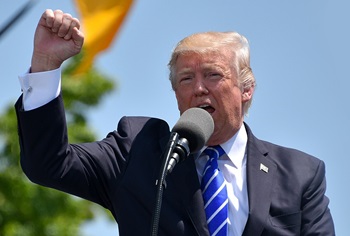
President Trump told Americans that higher gas prices are "a small price to pay" to stop Iran from building weapons capable of destroying Los Angeles and San Diego. Within hours, the quote had been surgically trimmed across social media to claim he said he'd let Iran take those cities.
The full sentence was about preventing an attack. The clipped version made it sound like Trump is ok with losing a couple of liberal-run cities.
Trump's argument was straightforward: confronting Iran's weapons program now — even if it means a temporary spike in energy costs — beats waiting until a regime that has openly called for the destruction of the United States has the capability to follow through. The cities were his example of what's at stake, not what he was offering up.
Steve Skojec, who is no reflexive Trump defender, conceded the phrasing "wasn't the most artful way to say it" but confirmed the meaning was clear in context: higher prices now prevent Iran from acquiring the destructive capabilities that would put American cities in the crosshairs. Even the critics who admitted they'd watched the full clip couldn't sustain the original accusation. They downgraded from "Trump wants Iran to nuke us" to "well, he could have worded it better."
That retreat tells you everything. The people who spent a full news cycle pretending Trump offered up two American cities to a hostile foreign power quietly pivoted to a style critique once the transcript was available. Nobody retracted. Nobody corrected the record. They just moved on to tone-policing the same statement they'd spent the morning calling treasonous.
The mechanics here are worth noticing because they never change. A Trump statement gets compressed until the meaning inverts. The compressed version rockets across platforms while the original sits behind a click nobody makes. By the time the correction arrives, the lie has been screenshotted, quoted, and embedded in three opinion columns. The correction gets a fraction of the engagement. The people who pushed the distortion keep their followers. This cycle has run — conservatively — dozens of times since 2015.
The original quote referenced Los Angeles and San Diego as cities that would be in range of an Iranian weapon if the program isn't stopped. Trump framed paying more at the pump as the trade-off for not having to find out whether Iran's promises to destroy America are rhetorical. That's a policy argument. You can disagree with the policy. What you can't do — not honestly — is pretend the man advocating for preventing an attack on American soil was endorsing one.
The clipped version required removing the word "preventing" and everything around it. That's not a misunderstanding. That's editing.