
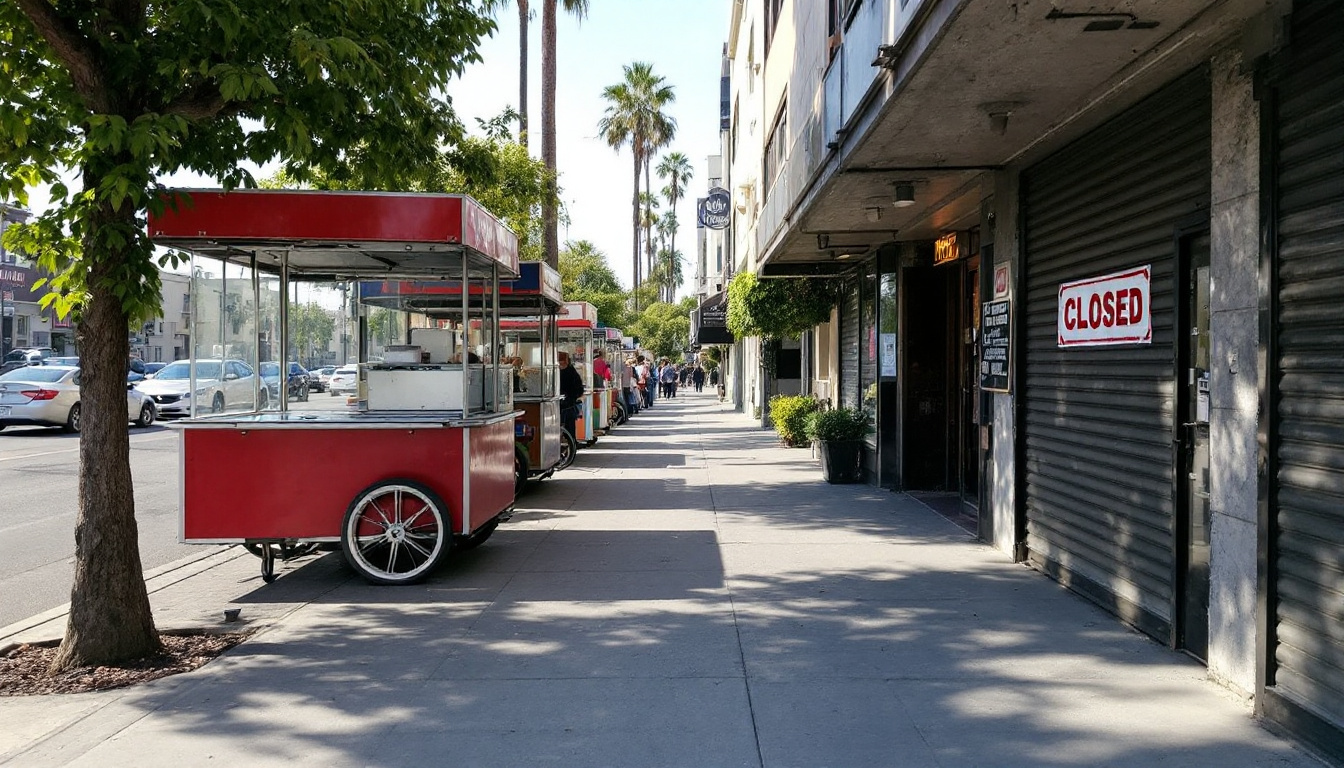
Anthony "Reed" Deugenio spent years doing everything right. He registered his business, passed a criminal background check, got a seller's permit and a tax ID, met every health and safety inspection requirement, and opened Big Dix Hot Dogs in West Hollywood. His reward for following the rules: watching his annual revenue drop from $100,000 to $30,000 as unlicensed vendors — many of them illegal aliens — set up shop on the same sidewalks with zero oversight.
Los Angeles County suspended street vendor enforcement entirely in fall 2025.
The reasoning was that federal immigration enforcement made it too risky for county inspectors to interact with unlicensed vendors. So Dr. Barbara Ferrer, the Los Angeles County Health Director, effectively waved the white flag. Rather than enforce the health codes that every brick-and-mortar restaurant in the county must follow, the county just stopped enforcing them for an estimated 10,000 unlicensed food vendors operating on LA sidewalks.
The numbers tell the story. Los Angeles has roughly 50,000 street vendors generating a combined $504 million in revenue. Of those, only 687 had active permits in 2024 — just 1.4 percent. Only 53 of those permits were for food vendors. Meanwhile, over 100 licensed LA restaurants were shut down in 2025, and the county fielded 2,957 food poisoning complaints the same year.
"I follow the rules — inspections, health standards, permitted areas," Deugenio told Breitbart. "Meanwhile, unlicensed vendors break the rules openly."
He's not the only one watching his livelihood evaporate under a two-tier system. Carlos "Robert" Haro, a third-generation owner of Casablanca restaurant, sells burritos for $12 — competing against unlicensed vendors charging $15 for the same product without paying for permits, insurance, worker's compensation at $12 per $100, or the standard 30 percent labor, 30 percent food, and 30 percent overhead that leaves legal operators with a 3-to-5 percent profit margin if they're lucky.
"It used to be you started out with a food truck," Haro said. Now you start with a folding table and a prayer that the county keeps looking the other way.
The legislative trail explains how we got here. In 2018, then-Governor Jerry Brown signed SB 946, which decriminalized noncompliant street vending statewide. In 2021, the LA City Council established a moratorium on citations for unpermitted vendors. Then Governor Gavin Newsom signed the Street Vendor Business Protection Act, which went further — prohibiting municipalities from collecting citizenship or immigration status, requiring fingerprinting or background checks, or sharing vendor information with immigration enforcement agencies.
State Senator Maria Elena Durazo pushed the framework. Mayor Karen Bass presided over a city that responded by slashing the annual street vendor permit fee from $541 to $27 and launching a $2.8 million Sidewalk Vending Cart Program promising 280 free carts to vendors. The message to legal operators: we'll make it as easy as possible for your unlicensed competition to keep undercutting you.
Other cities figured out enforcement just fine. Santa Monica charges $75 per year for a permit and actually enforces it. Huntington Beach fines violators up to $1,000 per violation per day. But LA chose a different path — one where a Sherman Way video of unlicensed vendors hit 100,000 views because residents could see with their own eyes what their government refused to address.
The county's stated plan going forward is to target "central food preparation hubs" rather than individual street-level operators. In practice, that means the vendor on the corner still doesn't get inspected, still doesn't carry insurance, still doesn't pay worker's comp, and still doesn't face consequences — while the restaurant owner next door sweats through every quarterly inspection knowing one missing hand-washing station could end the business his family spent three generations building.
Same sidewalk. Same city. Different rules based on whether you followed them in the first place.