
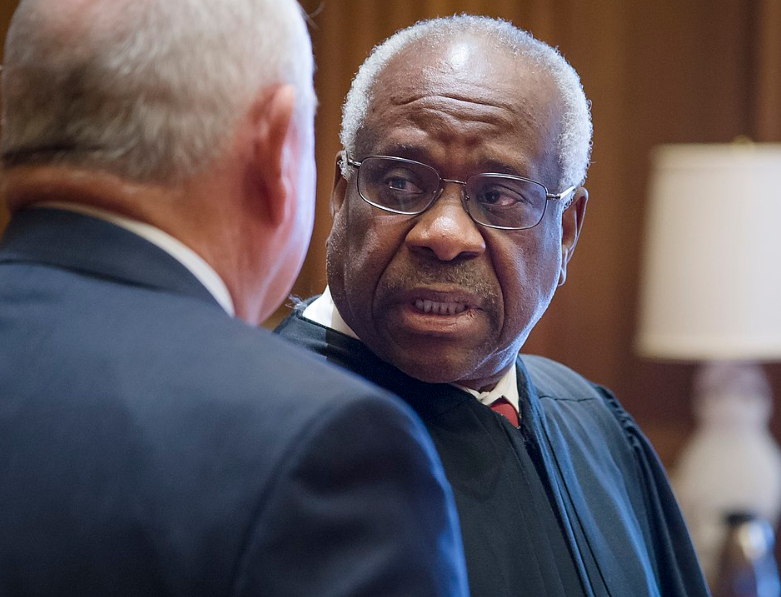
Supreme Court Justice Clarence Thomas sat across from Senator Ted Cruz on the "Verdict With Ted Cruz" podcast last week, looked into the camera, and said five words that will haunt every left-wing commentator who's ever questioned his Blackness: "You confuse me with someone who's been in indentured servitude or something."
Thirty-five years on the Supreme Court, and the man still has to explain to strangers why his skin color doesn't come with a voter registration card.
The interview was part of roughly nine hours of conversation Cruz conducted for his forthcoming book, Going Further: The Incomparable Clarence Thomas. And the Justice, now the longest-serving member of the current Court, used the platform to do something he rarely does in public — talk about the specific moment the American left lost him forever.
"When I came to this town, one of the greatest difficulties, if you think about it, was that there were those who thought that I should think a certain way," Thomas told Cruz. Not that he should think carefully. Not that he should think deeply. That he should think a certain way — the approved way, the permitted way, the way his complexion allegedly required.
Thomas traced the expectation back decades, describing the unspoken mandate as "stay Black and die" — his blunt summary of the rules imposed on Black Americans who wandered off the ideological reservation. Those were, as he put it, "these sort of requirements for us… because of our skin color."
The phrase "indentured servitude" wasn't an accident. Thomas chose it with the precision of a man who's spent a career selecting words that will survive appellate review. The implication is unmistakable: the left's demand that Black Americans vote, think, and speak in lockstep with the Democratic Party isn't solidarity. It's ownership with better branding.
Thomas also described the event that cracked his early left-wing worldview wide open. In 1970, as a student near Harvard Square, he attended a demonstration protesting the trial of Black Panther leader Bobby Seale and the Vietnam War. The protest turned into a riot. Thomas watched the destruction and arrived at what he called his ideological turning point.
"And that was the moment for me, when I began to move in a more positive direction," he said.
A more positive direction. Not a more conservative direction, not a more Republican direction — a more positive one. The word choice matters. Thomas doesn't frame his journey as leaving the left. He frames it as arriving somewhere better.
Every Black conservative in public life — from Senator Tim Scott to commentators like Candace Owens — has received some version of the treatment Thomas described. The playbook hasn't changed since Thomas arrived in Washington: question their authenticity, question their motives, question whether they're really Black in any way that counts.
Thomas addressed that too, invoking his grandfather's perspective. "What country is better than this country with all its problems?" he asked. It's the kind of question that gets you called a sellout in certain zip codes and a patriot in others.
The left's problem with Clarence Thomas has never been judicial philosophy. Plenty of liberal legal scholars disagree with originalism without calling its practitioners racial traitors. The problem is that Thomas exists. A Black man from Pin Point, Georgia, raised by his grandfather, educated at Yale Law School, who looked at the full menu of American political thought and ordered something the Democratic Party didn't approve — that's not a legal disagreement. That's an existential threat to a coalition that depends on uniformity.
Cruz's book will reportedly cover the full scope of those nine hours. If the podcast excerpt is any indication, the Justice had plenty more to say.
When a Supreme Court Justice uses the language of bondage to describe what his own political allies on the left once expected of him, that's not commentary. That's testimony.