
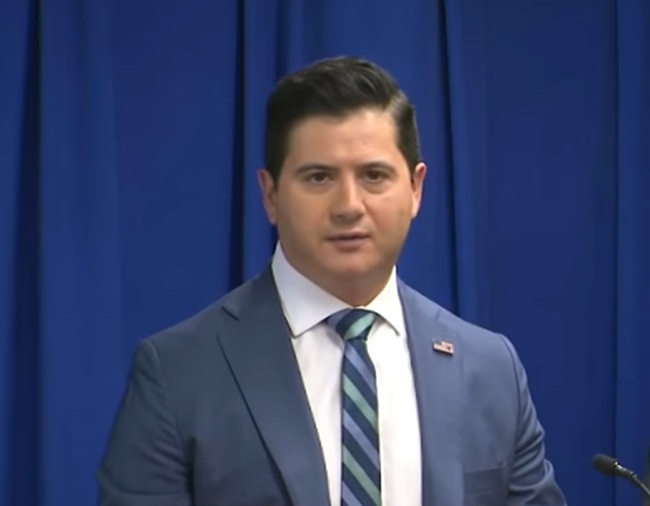
On Tuesday, Bill Essayli spent nearly three hours in a Los Angeles federal courtroom arguing about mail ballots. The Justice Department says the ballots came from about 20,000 likely noncitizens on California's voter rolls. His office had witnesses ready to testify.
When he walked out, a Los Angeles Times reporter was waiting with news. Another federal judge had just ruled that Essayli was "unlawfully serving as a 'de facto' United States Attorney."
Essayli didn't flinch. "Ultimately, this question will be decided by the Supreme Court," he said, "and I look forward to serving in my current role until then."
Essayli runs the Justice Department's office for the Central District of California, which covers Los Angeles and nearly 20 million people. He's a former federal prosecutor who worked in the same office from 2014 to 2018, and he served four years in the California Assembly. Attorney General Pam Bondi put him in charge in April 2025.
Since then, he's been one of the most aggressive prosecutors in the country. He's gone after health care fraud in California, prosecuted people who attacked or obstructed immigration agents, and challenged the state over noncitizens on its voter rolls.
The ruling has nothing to do with whether he's good at the job. It's about paperwork.
A federal law called the Vacancies Reform Act limits how long someone can serve as an acting U.S. attorney without Senate confirmation. After Biden's U.S. attorney in Los Angeles, Martin Estrada, stepped down, the Trump administration used a series of appointments to keep Essayli in charge, eventually naming him the office's First Assistant U.S. Attorney.
Judge J. Michael Seabright, a Hawaii judge brought in to hear the dispute, says that maneuver crossed the line. He already ruled against Essayli once, in October 2025. This time he pointed to an August decision by the 9th Circuit Court of Appeals that struck down a nearly identical arrangement for Sigal Chattah, the Trump administration's top prosecutor in Nevada. Seabright disqualified Essayli from supervising two criminal cases, though he refused the defendants' requests to throw out their indictments.
Essayli isn't going anywhere for now. The order is on hold while the Justice Department asks for a stay, and the department has already asked the Supreme Court to overturn the Nevada ruling.
"We respectfully disagree with the court's order," Essayli said. "The President and the Attorney General have every right to select supervisors within the Justice Department."
There's a reason Trump keeps having to use workarounds. Under a long-standing Senate tradition known as the "blue slip," a president's U.S. attorney nominee generally needs a sign-off from both home-state senators. In California, those senators are Democrats Adam Schiff and Alex Padilla. Neither is going to approve a Trump prosecutor who's going after the state's voter rolls and protesters who attack ICE agents.
So the Senate route is blocked, and now the courts are blocking the workaround too.
Essayli isn't the only one. Judges have ruled the same way against Trump's picks in Nevada, New Jersey, where Alina Habba led the office, and upstate New York. In each case, a judge decided that a prosecutor chosen by the president couldn't keep leading the office.
The ballot case is still moving. Judge David Carter appointed a special master on Tuesday and said he'd issue an order Wednesday.
Essayli is still running the office. The question of whether he can stay is headed to the Supreme Court.