
An internal Army Reserve message sent last week directed commands across the force to report which units — military police, engineers, surgeons, logistics battalions — could be available for deployment in 90 to 120 days. The deadline for responses: September 25. Yesterday.
The document never mentions Cuba. Multiple U.S. officials told CBS News it doesn't have to.
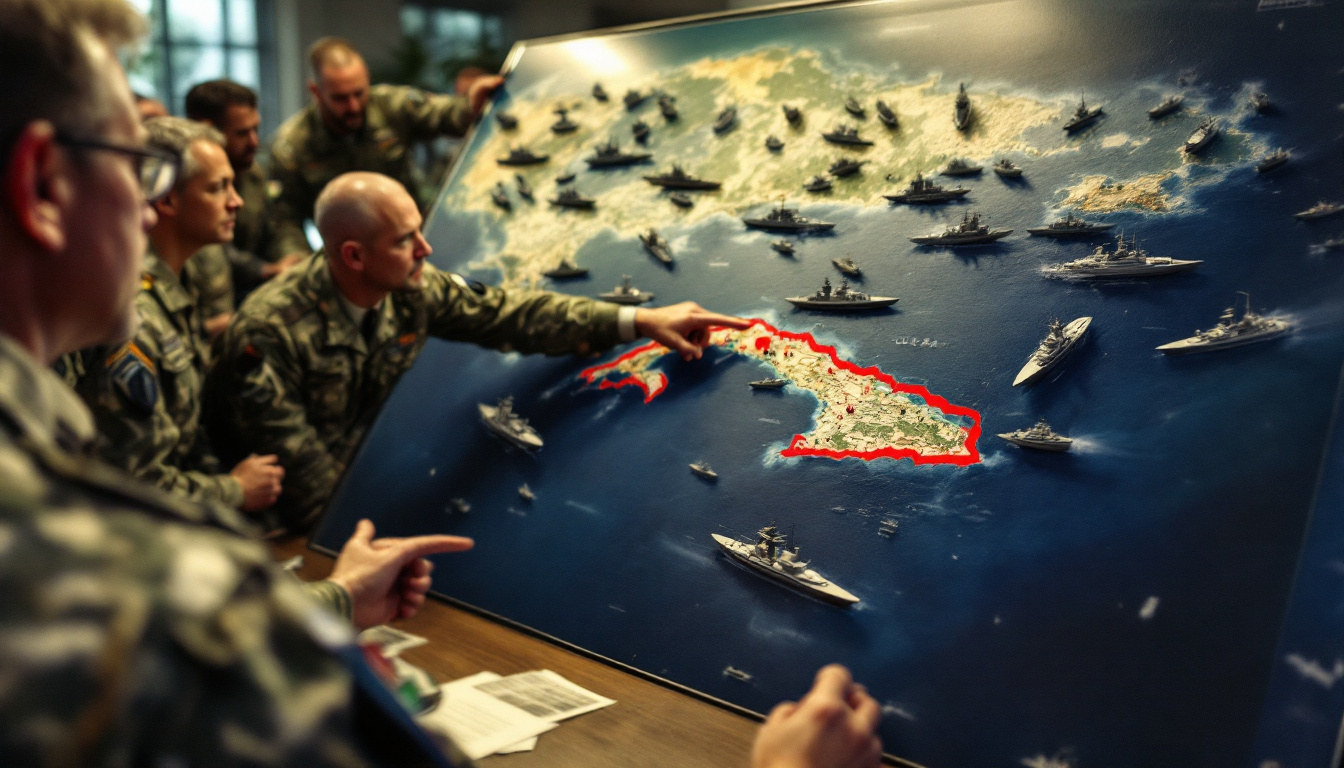
The message asks whether the Army Reserve can provide U.S. Southern Command with a combat sustainment support battalion to coordinate transportation, maintenance, fuel, and supply operations. It also requests an engineer battalion, an expeditionary sustainment command to oversee logistics across an entire theater of operations, a medical brigade, a forward resuscitative and surgical detachment for emergency battlefield care, and a military police brigade. Units "possibly needed in 90-120 days," the document states.
No deployment orders have been issued. A U.S. Southern Command spokesperson said the command does not "disclose details or comment on U.S. operational movements or potential deployment timelines" due to operational security concerns. That's the kind of non-denial that tells you more than a denial would.
This isn't coming out of nowhere. American forces have already conducted seafloor reconnaissance around Cuba earlier this year. U.S. airpower components were placed on heightened readiness. Previous deployment planning was developed but, according to CBS News, "did not come to fruition." The planning continued anyway.
President Trump has been the opposite of ambiguous. Back in March, he told reporters he wanted "the honor of taking Cuba" and added: "Taking Cuba in some form, yeah... Whether I free it, take it — I think I could do anything I want with it, if you want to know the truth." He followed that with a flat declaration: "Cuba's going to be next."
At the United Nations General Assembly this week, Trump went further, saying his administration seeks "fundamental change" on the island and predicting that Cuba's government "will fall." The Cuban delegation walked out during the remarks.
Cuban President Miguel Díaz-Canel responded by accusing Washington of "aggression" and "economic warfare" and vowing to counter any U.S. attack. Meanwhile, Secretary of State Marco Rubio is described as "deep into negotiations" with Havana — the carrot to the military planning's stick.
The broader Western Hemisphere posture backs this up. U.S. military strikes in the region have killed more than 230 people since September, with 70 strikes conducted in the Caribbean Sea and eastern Pacific Ocean. Last Thursday, more than 30 members of the Jalisco New Generation Cartel were arrested in a joint U.S.-Ecuador operation. The Monroe Doctrine — or as Trump's version is sometimes styled, the "Donroe Doctrine" — isn't a speech line. It's an operational tempo.
Cuba has announced nearly 200 free-market reforms in what looks like an attempt to get ahead of the pressure. The intelligence community's 2026 annual threat assessment portrays Cuba less as an independent strategic threat and more as an enabling environment for larger geopolitical competitors — which is precisely the kind of language that justifies action rather than patience.
The 101st Airborne Division remains the only unit trained for Army-led air assault operations. The units listed in the Army Reserve message — logistics, engineers, medical, military police — are what you request when you're planning to sustain a presence, not just make a point.
Combat sustainment support battalions don't deploy for exercises. Forward surgical detachments don't mobilize for press conferences. When the Army starts asking who can be ready by late December, the question isn't whether something is being planned. It's how far along the planning already is.