
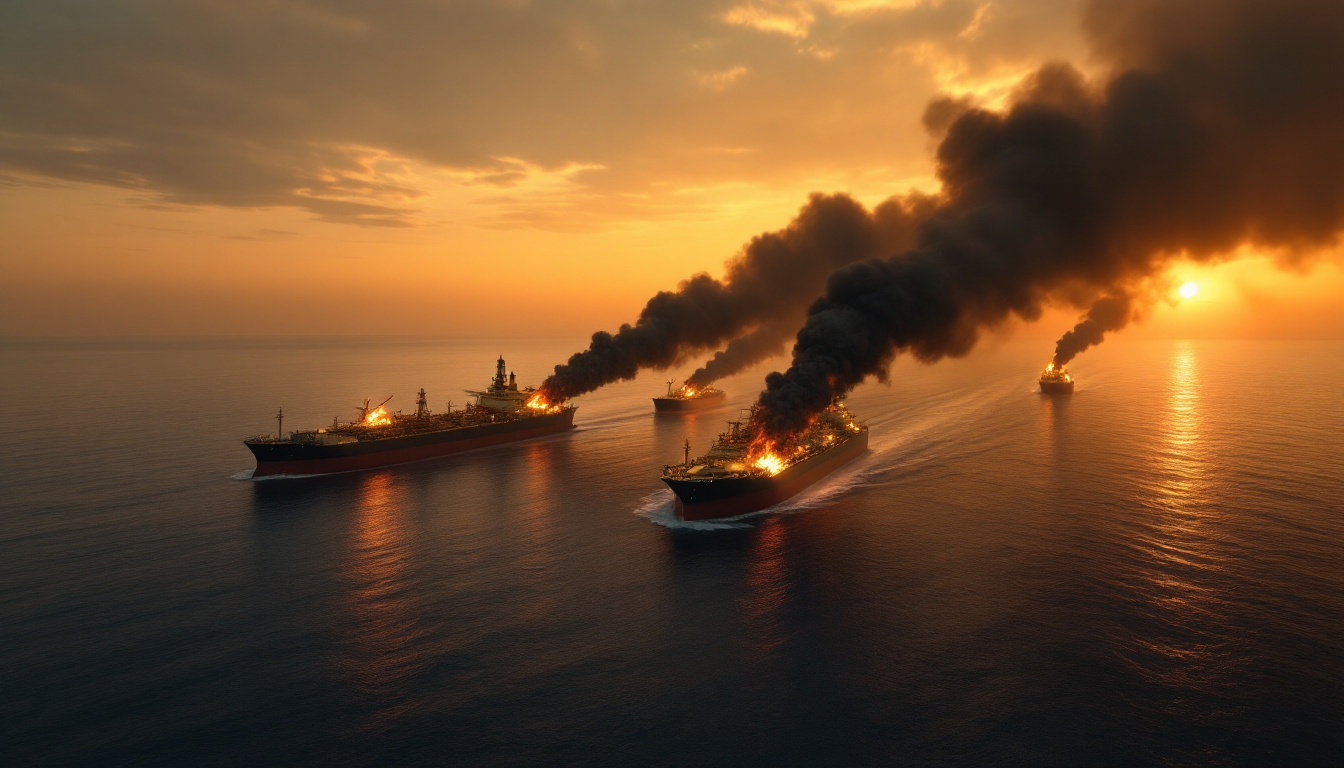
The M/T Downy sat off the coast of Kharg Island on Saturday morning. By Saturday afternoon, it was permanently disabled, along with two other Iranian oil tankers — the M/T Stark 1 near Jask and the M/T Kylo/Noxen in the Gulf of Oman. Three vessels that funded the Islamic Revolutionary Guard Corps.
Iran fired ballistic missiles at two U.S. Navy warships — an aircraft carrier and a guided-missile destroyer. Zero American personnel were harmed.
CENTCOM Commander Admiral Brad Cooper didn't leave much room for interpretation. "If you shoot at two of our ships, we will impose an even higher economic cost — taking out three of yours," Cooper said. Then he added what amounts to a standing invitation for Iran to try again: "We will not hesitate to defend American forces, and if necessary, destroy Iran's limited and exposed oil fleet."
That phrase — "limited and exposed" — is doing a lot of work. It's not diplomatic language. It's an inventory assessment delivered in public, on the record, to a regime that just found out exactly how exposed its assets are. Cooper essentially told Iran's military leadership that the United States knows where every vessel in their fleet is sitting and can reach any of them whenever it wants.
Iran, predictably, claimed it successfully struck an American vessel. The Pentagon's response was simple: no, you didn't. No damage. No casualties. The only ships that took hits were flying Iranian flags.
The IRGC-linked tankers weren't just carrying oil. According to CENTCOM, these vessels directly funded the IRGC and its regional proxy networks — the same networks that have destabilized Iraq, Syria, Yemen, and Lebanon for decades. Destroying them wasn't just a military response. It was an economic strike against the financial pipeline that keeps Iranian-backed militias operational across the Middle East.
The timing matters. This exchange comes as the IAEA nuclear escalation heads to the UN Security Council, where the usual crowd will argue for restraint, diplomacy, and carefully worded resolutions that accomplish nothing. Meanwhile, the U.S. military just demonstrated that the fastest diplomatic channel in the region runs through the flight deck of an aircraft carrier.
The contrast with previous administrations doesn't need much commentary. When Iran seized U.S. Navy sailors in 2016 and paraded them on state television, the response was an apology. When Iranian proxies attacked American bases across Iraq and Syria for years, the response was proportional strikes on empty buildings after advance warning. The word "proportional" did a lot of heavy lifting in those years. It meant: we'll hit something, but nothing that matters.
Three tankers permanently removed from Iran's oil fleet. Zero American casualties. A CENTCOM commander who publicly told Iran he knows exactly how small and vulnerable their navy is.
When the math is that simple, even the UN Security Council can follow it.