
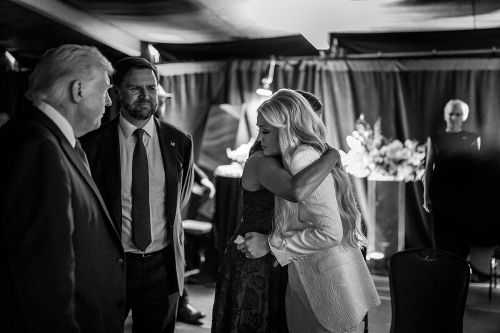
Erika Kirk sat in a courtroom this week and listened to a police officer describe, in clinical detail, the moment a 23-year-old with a rifle ended her husband's life. She left in tears. Charlie Kirk's mother and father were there too.
Nearly a year later, the family still has to sit through this.
The preliminary hearing in the case against Tyler Robinson, the man accused of shooting Turning Point USA founder Charlie Kirk at a campus speaking event at Utah Valley University in September 2025, got underway this week before Judge Tony Graf. The purpose of the hearing is narrow — determine whether enough evidence exists to proceed to a full trial. But the testimony was anything but narrow.
Officer Chris Bagley, a former campus police officer at Utah Valley University, took the stand and walked through the sequence of events that ended with Kirk on the ground. Bagley's testimony included forensic details about the weapon's positioning and the moment the shot was fired. Prosecutors presented photographs from the scene.
The courtroom saw what Erika Kirk has had to carry for ten months.
Charlie Kirk built Turning Point USA into one of the largest conservative youth organizations in the country. He went to college campuses — the places most hostile to his ideas — and made the case anyway. That's what he was doing at Utah Valley University the night he was killed. Showing up.
The defense has signaled it may pursue a mental health argument. That's not surprising. It's the play when the facts of what happened aren't in dispute, only the why. Whether Robinson understood what he was doing, whether he was competent, whether the legal system should treat a man who brought a rifle to a speaking event and pulled the trigger as something other than what that act plainly is.
We'll see how that goes.
What the preliminary hearing made clear is that the prosecution intends to build its case methodically. Bagley's testimony about security failures at the event suggests prosecutors are documenting not just what Robinson did, but how he was able to do it — the gaps that let a 23-year-old get a rifle within range of a public figure at a campus event.
That's a question worth answering, and not just for this case. Conservative speakers have faced escalating threats on college campuses for years. Speeches shouted down, events canceled under pressure, speakers physically confronted. The rhetorical climate that treats conservative voices on campus as inherently dangerous — as threats to be neutralized rather than ideas to be debated — didn't pull the trigger in September 2025. But it built the room where pulling the trigger became possible.
Nobody in the mainstream press spent much time on that question after the shooting. The coverage was dutiful and brief. A conservative media figure was murdered at a campus event, and the story cycled out of the national conversation in a matter of days. Compare that to the weeks-long saturation coverage that follows when political violence runs in the other direction.
Erika Kirk doesn't get to cycle out of it. She was in that courtroom on Monday, watching photographs of the worst moment of her life entered into evidence while attorneys discussed forensic trajectories and weapon positioning. Kathryn Kirk was there, watching the legal system process her son's murder one procedural step at a time.
Judge Graf will determine whether the case moves forward to trial. Based on the evidence presented so far, that seems likely. The larger question — whether anyone outside that courtroom will pay attention when it does — is a different matter.
Charlie Kirk spent his career trying to get young conservatives to show up in places where they weren't welcome. The hearing this week was a reminder of what that cost. The photographs entered into evidence don't need editorial commentary. They speak for the family that has to sit there and look at them.