
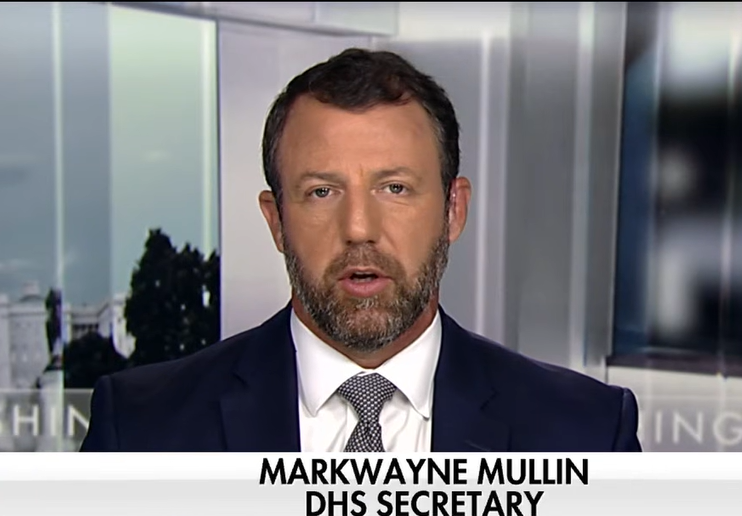
Within the next six weeks, the Department of Homeland Security expects to surpass the total number of deportations carried out in all of 2025. That's not a projection from some think tank white paper. That's straight from the mouth of DHS Secretary Markwayne Mullin on his 100th day on the job with the kind of numbers that make open-borders advocates reach for the mute button.
"We're on a path this year — '26 — to well past what we did in '25," Mullin said.
The former Oklahoma senator took over DHS after President Trump reassigned Kristi Noem to handle Latin American affairs. Mullin inherited 22 components across the sprawling department — ICE, CBP, Homeland Security Investigations, and more — and by his own account, the machinery is running harder than it has in years. The 100-day milestone landed Thursday, and the interview dropped with it.
The enforcement picture Mullin paints isn't just about volume. It's about who's getting picked up. Seventy percent of those arrested have pending or prior felony charges. When agents execute a warrant at a single location, they're averaging over four illegal aliens per stop — meaning every targeted operation nets three or four additional people who weren't even the primary target but were living in the same location unlawfully.
"We've released no one into this country that we've apprehended," Mullin told Breitbart. "We went 13 months straight here now that we haven't released one single person."
Thirteen months of zero catch-and-release. That sentence would have been science fiction under the previous administration, which released somewhere between 10 and 20 million illegal aliens into American communities as a matter of policy.
The numbers on terrorism are the ones that should make everyone pay attention regardless of politics. Mullin said agents have arrested just over 1,900 terrorists in interior operations during Trump's second term. At the northern border — all 5,400 miles of it — agents are picking up Iranian nationals and other foreign-born individuals of concern at a clip of three to four per week, numbers Mullin described as being in the "single digits" for Iranians specifically but steady enough to warrant serious attention.
Then there are the children. Under the Biden administration, approximately 450,000 minors who crossed the border were effectively lost — no tracking, no follow-up, no accountability. Mullin said 147,000 have been located since Trump took office. That leaves 300,000 still unaccounted for.
"We're still looking for 300,000 children," he said.
Three hundred thousand kids the federal government placed with sponsors it never verified, in homes it never checked. The scale of that failure is difficult to process even as a raw number. Each one represents a child who entered a system that was designed to move bodies, not protect people.
Mullin also addressed the wall — the physical barrier Trump first campaigned on in 2016 and began constructing during his first term. "From the Pacific to the Gulf of America this time next year... primary wall complete," he said, describing a smart wall system with primary and secondary barriers spaced 60 to 150 feet apart, integrated with sensors and drones.
On the cooperation front, Mullin praised Florida and Oklahoma as the best states for utilizing the 287(g) program, which allows local law enforcement to partner with federal immigration authorities. California, New Jersey, and Virginia drew the opposite distinction — sanctuary states that actively limit cooperation with ICE.
The state-level resistance tells you something about where the real political battle lines are. Local officials in sanctuary jurisdictions aren't protecting their communities. They're protecting a policy preference, and the 70 percent felony rate among those being arrested suggests the people they're shielding aren't the sympathetic figures the sanctuary movement needs them to be.
Mullin, for his part, said he still relishes the job. "I still love it. I still, every single day I walk in, I think I'm still the luckiest man."
A DHS secretary who considers it lucky to enforce the law. After the last administration treated the border like a suggestion box, the contrast writes itself.