

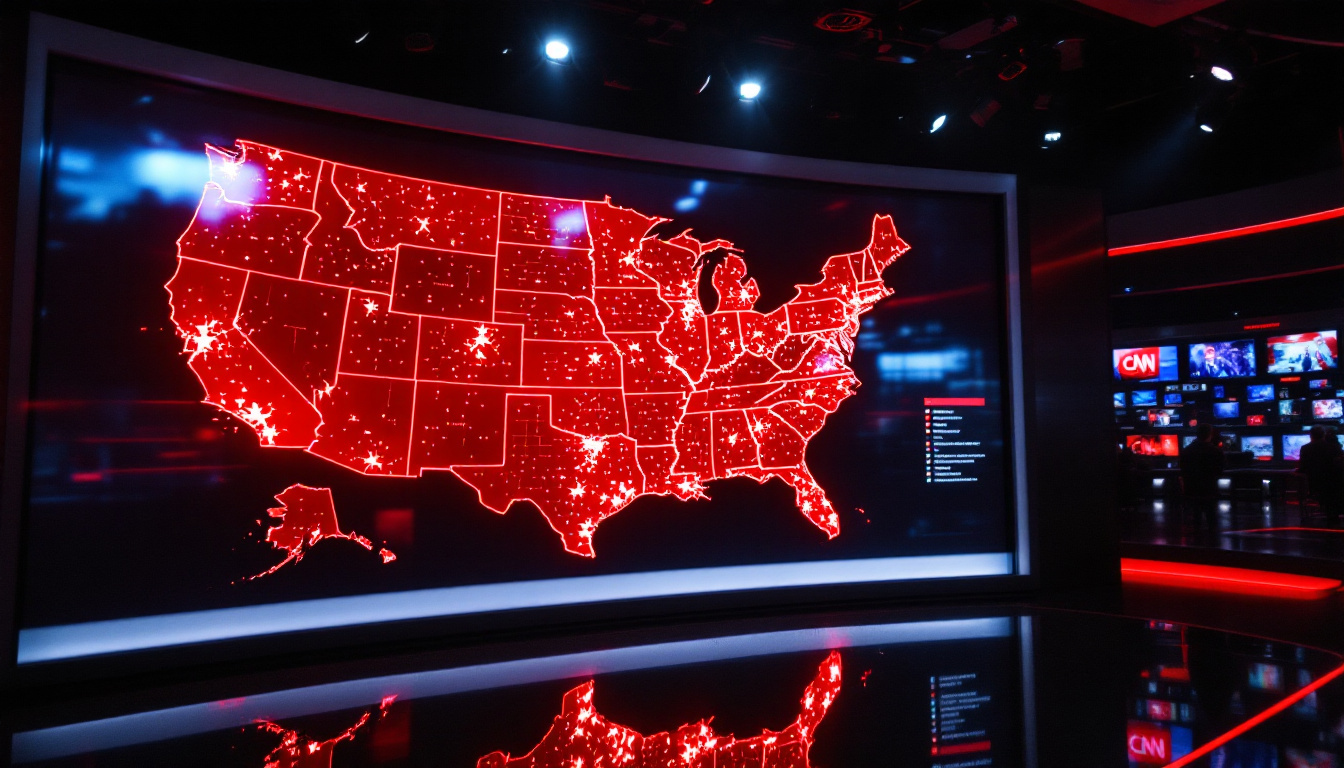
Harry Enten, CNN's chief data analyst, stood at his magic wall last week and did something his network almost never does — he told the truth about the polls. Specifically, that they've been undercounting Republican voters for three decades, and if they're doing it again in 2026, Democrats aren't just going to lose the Senate. They're going to get steamrolled.
The current GOP majority sits at 53-47. Enten's math makes it worse.
"Let's just say we have the 2026 Senate polls, but if the polls are underestimating the Republicans by 3.5 points, which you know is really possible, because we've seen it through the history, right?" Enten said. "You go back to 2020, that's basically what happened."
He wasn't speculating. He was reading the receipts. Since 1994, early October generic ballot polls have underestimated Republicans in 14 out of 16 cycles. The average miss: four points. Not a rounding error. Not a one-time fluke. A pattern that spans eight presidential administrations and three decades of data that pollsters keep acknowledging and never fixing.
"Even in 2024, in a number of the key states we saw it happen, including places like Texas," Enten added. Texas — a state nobody seriously thought was competitive — still saw polls tighter than reality. The invisible Republican voter isn't a conspiracy theory. CNN's own numbers man is mapping it on a touchscreen.
So what happens when you apply the historical correction to the current Senate map? Enten walked through it state by state: "How about Michigan? How about up there in Maine, how about in Alaska, how about in Iowa, how about in Kansas — which has been getting a lot of press lately — all of these go red." The result, per Enten's own model: "Republicans don't just hold the United States Senate; they hold it easily with 52 seats to the Democrats' 48 seats."
That's not a Republican strategist spinning on Fox News. That's CNN's in-house data analyst, on CNN's air, telling CNN's audience that the numbers favor the GOP even before you factor in the money.
And the money is staggering. President Trump's political operation through MAGA Inc. is positioned to deploy between $400 million and $500 million into midterm races, as reported by The Gateway Pundit, citing The Western Journal. Elon Musk has committed roughly $300 million of his own to key contests. Combined, that's the kind of financial firepower that doesn't just compete — it buries.
Senate Minority Leader Chuck Schumer seems to understand the problem, even if his diagnosis is conveniently incomplete. "We have strong candidates, a clear message, and a political climate that offers real opportunities," Schumer said. Then came the admission buried in the fundraising pitch: "But Republicans have one enormous advantage of their own. Money."
"That's the enormous force bearing down on this election," Schumer continued, "a challenge none of us can afford to underestimate."
Money is the problem Schumer can say out loud. The one he can't is that his party's candidates are running in a country where the polls keep missing the same voters — the ones who don't talk to pollsters, don't put signs in their yard, and show up on Election Day like clockwork. Enten's own framing — "What is going on here?" — tells you even the analysts aren't sure where these voters come from. They just know they keep arriving.
The states on Enten's correction map tell the larger story. Michigan, Maine, Alaska, Iowa, Kansas, North Carolina, New Hampshire, Georgia — these aren't deep-red gimmes. Several of them are states Democrats have spent years and millions trying to make permanently competitive. If a 3.5-point correction flips all of them, the Democratic Senate strategy isn't just struggling. It was built on polling that's been wrong since Bill Clinton's first midterm.
Fourteen of sixteen cycles. Four-point average. CNN's own data wall.
Schumer called money the force bearing down on this election. Enten's numbers suggest the force has been there since 1994.