
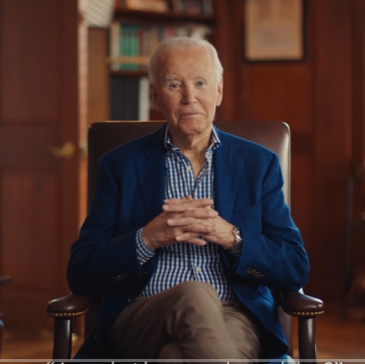
A three-judge panel on the U.S. Court of Appeals for the D.C. Circuit ruled 2-1 on Monday that audio recordings and transcripts of Joe Biden's interviews with his memoir ghostwriter Mark Zwonitzer must be released to the public. The recordings were made at Biden's home in 2016 and 2017 while Zwonitzer, a ghostwriter, worked on two Biden memoirs.
Biden's lawyers have until August 3 to figure out their next move.
The recordings became a flashpoint after Special Counsel Robert Hur investigated Biden's handling of classified documents from his Senate and vice presidential tenures. Hur ultimately declined to prosecute, citing Biden's addled capabilities, but his investigation produced a trove of material — including these ghostwriter interviews — that Republicans in Congress and the Heritage Foundation demanded to see. Biden's legal team fought disclosure, arguing the conversations were candid, personal, and meant to stay confidential.
The appeals court wasn't persuaded. The majority found a "substantial" public interest in releasing the material and concluded that "any remaining incursion on personal privacy from disclosure of the now-redacted materials likely does not outweigh the public interest in disclosure." Chief Judge Sri Srinivasan, an Obama appointee, and Judge Gregory Katsas, a Trump appointee, formed the majority. The Trump Justice Department had previously argued for disclosure under public records law.
Judge Florence Pan, a Biden appointee, dissented.
U.S. District Judge Dabney Friedrich had already ruled in June that the material should be released. Biden appealed. The appeals court agreed with Friedrich. The pattern here isn't complicated: every court that has looked at this has reached the same conclusion. The public has a right to hear what the former president told his ghostwriter during the same period he was, according to Hur's investigation, mishandling classified documents.
The Biden team's argument boiled down to privacy — that these were intimate, off-the-record conversations never meant for public consumption. Which is a fascinating position for a man who sat for interviews specifically to produce a published memoir. The parts he wanted the world to read became bestsellers. The parts he didn't want the world to hear became the subject of a special counsel investigation.
The Heritage Foundation and congressional Republicans pushed for this disclosure precisely because Hur's decision not to prosecute left unanswered questions. If the evidence wasn't sufficient to charge, fine — but the public still deserves to evaluate the underlying material. That's not a radical legal theory. That's how transparency works when a former president is investigated by his own Justice Department.
The recordings won't surface immediately. The court suspended its ruling until August 3 to give Biden's team time to seek further review. They could petition the full D.C. Circuit or try their luck at the Supreme Court.
But two different federal courts have now said the same thing. The privacy argument failed at the district level and it failed at the appellate level. The only judge who bought it was the one Biden appointed.