

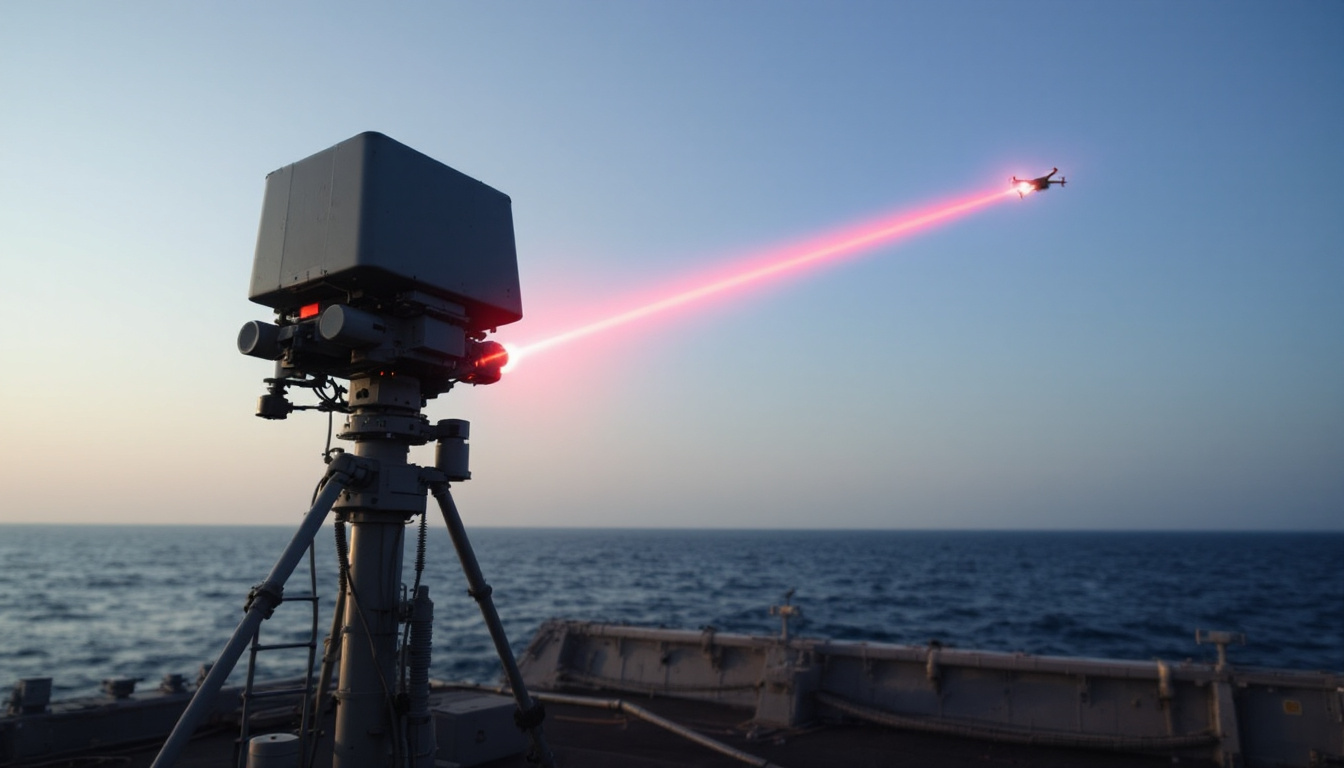
Somewhere in the Strait of Hormuz right now, a U.S. Navy sailor is sitting behind what looks like a gaming console, pointing an infrared beam at an Iranian drone, and watching it explode at the speed of light. The weapon doesn't make a sound. It doesn't leave a vapor trail. It costs a fraction of what a missile does. And Iran can't see it coming.
Fifty years of American laser research and our soldiers are using Xbox controllers to win wars. Diabolical.
The Pentagon has deployed directed-energy weapons — military-grade laser systems — to active combat positions targeting Iranian drones and cruise missiles in the Strait of Hormuz. These aren't prototype curiosities bolted onto a test ship for photo ops. They're functioning weapons systems that U.S. personnel are using right now to disable and destroy Iranian military hardware in real time.
Mark Neice, president of Directed Energy Consultants and one of the people who actually understands how these systems work, laid out the capability in terms even Congress could follow. "We can very specifically track and target drones and put the spot exactly where we want it, [in order] to disable its sensors or kill the drone itself," Neice said. Disable its sensors — meaning blind it — or detonate it outright. The operator picks.
The delivery mechanism is almost too good to be true. The laser targeting systems use controllers modeled on Xbox gaming hardware. The same muscle memory that millions of American kids built playing Call of Duty is now the interface for a weapon that travels at 186,000 miles per second. The Department of War's own secretary received hands-on training with the system. Not a briefing. Training.
What makes this different from every other Pentagon procurement story — where a program burns through decades and billions before producing a PowerPoint presentation — is that directed energy crossed the line from laboratory experimentation to operational combat use. That transition is the one most defense programs never make. The laser program made it.
The economics alone change the math of naval engagement. Every interceptor missile the Navy fires at an incoming Iranian drone costs somewhere between tens of thousands and millions of dollars depending on the system. A laser shot costs roughly the price of running a generator. Iran's strategy of overwhelming American defenses with cheap, expendable drones depends entirely on the assumption that each interception costs us more than each drone costs them. Directed energy inverts that equation. We can shoot down their hardware all day and the marginal cost approaches zero.
Russia and China are reportedly watching and developing their own counterparts, which is exactly the kind of sentence defense analysts write when they want more funding. But the relevant fact is that the United States got there first. Not theoretically. Operationally. In the strait where Iranian aggression actually happens, with American sailors actually pulling the trigger.
The fifty-year timeline matters. This didn't materialize out of a tweet or a campaign promise. It came from a half-century of sustained investment in directed-energy research that survived administration changes, budget fights, and periodic mockery from the same people who thought the Space Force was a punchline. Every skeptic who laughed at "laser weapons" as science fiction is now looking at combat footage of the science working exactly as designed.
President Trump's Department of War didn't invent the technology. But deploying it to an active theater — the Strait of Hormuz, where Iranian provocations against American naval vessels are a recurring reality — is a decision. It signals that the administration's posture toward Iranian military aggression isn't containment or negotiation. It's capability demonstration. The kind where you don't announce it at a press conference. You just turn it on.
Iran has spent years investing in drone swarm capability as its asymmetric answer to American naval superiority. The entire theory assumed interception would always be expensive and finite — that you could exhaust an American ship's missile inventory with enough cheap drones. That theory just ran into a beam of light that doesn't run out of ammunition.
The Strait of Hormuz handles roughly twenty percent of the world's oil traffic. Securing it has been an American mission for decades. The tools just changed.
An Xbox controller, an infrared laser, and the speed of light. Cost per shot: almost nothing. Rounds remaining: unlimited.